- Application lodged
- Processed quickly
- GS questions tend to get accepted
- Decision lands inside expected timeframe

Why Australian Student Visa Applications Are Being Refused in 2026: The MD 111 / 115 Reality
If your Australian student visa application has just been refused, or if you have been waiting eight months for a decision that should take six weeks, please hear this clearly first.
It is not necessarily about you.
It is not necessarily about your finances. It is not about your IELTS score being half a point lower than the friend who got approved last year. It is not about your statement of purpose. It is not about whether you "are a genuine student" in any meaningful, human sense of those words.
The single biggest factor in whether your application got refused or delayed in 2025 and 2026 was a Ministerial Direction issued in Canberra, the priority tier it assigned your education provider, and whether that provider had already hit its quota by the time your file landed on a case officer's desk. The system you applied into is a different system to the one your cousin used in 2022.
Here is what is actually happening.
General information only, not immigration advice for your situation. If your visa has been refused or you need help with a reapplication, speak with a registered migration agent at mara.gov.au.
Two applications, two outcomes, same applicant.
- Application lodged through low-tier provider
- Pushed into slow queue (80% threshold)
- GS questions cross-examined more aggressively
- CoE can expire before a decision is made
The 30-second version.
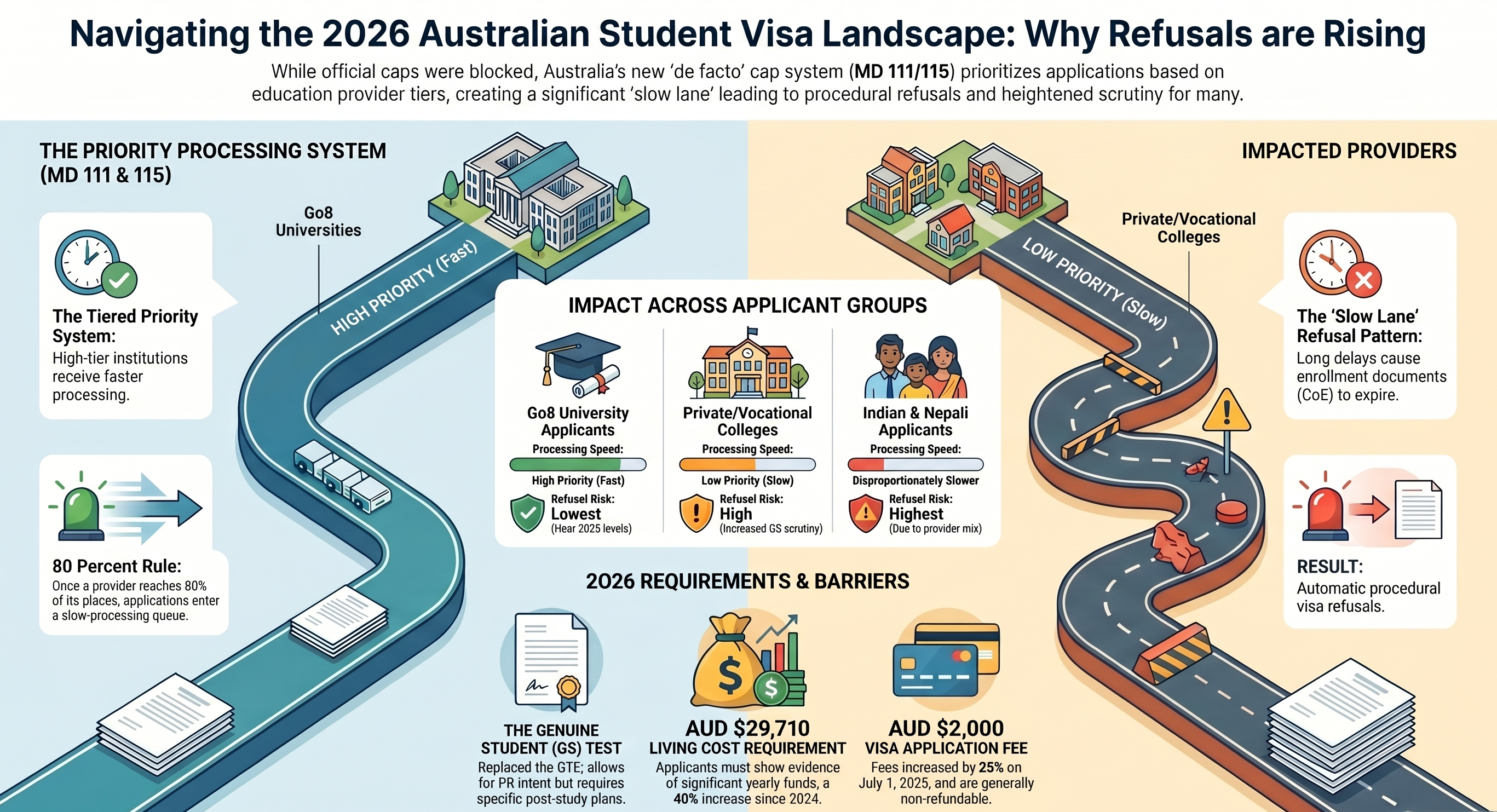
- The Senate blocked the official student visa cap on 28 November 2024. The ESOS Amendment Bill 2024 would have hard-capped new students at 270,000 for 2025. Coalition and Greens voted it down.
- The government replaced it with a de facto cap through three Ministerial Directions in sequence: MD 107, then MD 111, then MD 115 from 14 November 2025.
- The mechanism is processing priority, not refusal. Once your education provider hits 80% of its allocated places, applications get pushed into a slow queue. Same outcome, different machinery.
- The Genuine Student (GS) test replaced the GTE on 23 March 2024. The 300-word statement is gone. Targeted questions are in.
- The financial requirement is AUD $29,710 per year for living costs, up significantly from earlier years.
- Student visa fees jumped 25% on 1 July 2025, from $1,600 to $2,000 main applicant.
- Indian and Nepali applicants have been hit hardest. Refusal rates rose disproportionately, not because of fraud, but because their preferred providers were the ones most squeezed by the priority system.
- A refusal is not the end. Reapplication is possible. Review pathways exist. But understanding which Ministerial Direction your refusal was processed under is the first thing a migration agent will ask.
The cap that never legally happened.
This is the part that nobody outside the migration legal community properly understands, and it changes how to read every refusal of the last 18 months.
The ESOS Amendment Bill 2024 was the official, transparent attempt to cap international students at 270,000 for 2025, with sub-caps for each university and provider. It was tabled in the federal parliament. It was debated openly. And on 28 November 2024, the Senate blocked it. The Coalition voted no because they wanted lower caps. The Greens voted no because they opposed the cap principle. Together, the two opposition blocs killed the legislation.
What happened next is the bit that matters.
Within weeks, the government issued Ministerial Direction 107, which did not officially cap anyone but assigned processing priority across education providers. Providers were sorted into priority tiers. Higher-priority providers (mostly Group of Eight universities) had their applications processed quickly. Lower-priority providers (mostly smaller private colleges and certain vocational education providers) had their applications processed slowly.
MD 107 was then replaced by MD 111, which refined the mechanism. MD 111 applied to applications lodged before 14 November 2025. The current direction is MD 115, which applies to applications lodged on or after 14 November 2025.
The cumulative effect of the MDs is what people inside the system call the "80 percent rule." Once a provider hits 80% of its allocated places for the program year, applications through that provider get pushed into the slow processing lane. Same numerical outcome as a hard cap. Different legal mechanism.
OFFICIAL ·You can read the official current direction here:Student visa processing priorities(the IMMI page links to the current MD).

So why are people getting refused, not just delayed?
This is the second important part of the picture. The MDs do not officially refuse anyone. They prioritise. But the priority system creates the conditions for two refusal patterns that have driven the headline numbers.
Pattern one: the timing-out application.
If your provider is in a low priority tier and your file sits in the slow queue, your CoE (Confirmation of Enrolment) can expire before a decision is made. When the CoE expires, the application is refused on procedural grounds. The refusal letter does not mention MD 111. It mentions the CoE. But the underlying cause is the priority system.
Pattern two: the Genuine Student test, applied harder in the slow lane.
When a case officer has more time per file (because the slow queue gives them more time), they probe the application more aggressively. The Genuine Student requirement, which replaced the old GTE on 23 March 2024, asks targeted questions about why you chose this course, this provider, this location, and your post-study plans. In the fast lane, those answers tend to get accepted. In the slow lane, they get cross-examined.
The end result: applicants through low-priority providers face higher refusal rates, longer waits, and tougher GS scrutiny than applicants through high-priority providers, even when the personal circumstances are similar.
This is the policy hiding inside the processing system. It is real, it has been documented by ICEF Monitor and SBS News, and it explains the refusal pattern of the last 18 months better than any other single factor.
The Genuine Student test, in plain English.
The old Genuine Temporary Entrant (GTE) requirement asked you to write a 300-word statement explaining why you would leave Australia after your studies. It punished honesty about wanting to seek PR later.
The Genuine Student (GS) test, which replaced it on 23 March 2024, is a targeted questionnaire. The questions cover:
- Your current circumstances (ties to your home country, education history, employment history)
- Why you chose this course
- Why you chose this provider
- Why you chose Australia over other countries
- How the course relates to your future plans
- Your immediate post-study plans
A useful and underappreciated detail: the GS test explicitly accepts that genuine students may seek PR later. This is a real shift from the GTE, which used PR intentions against you. If your honest answer is "this course will help me qualify for a 485, and eventually I want to apply for skilled migration," the GS framework does not punish you for saying so.
Where the GS test still goes wrong for applicants: vague answers, course-provider mismatches (why is a finance graduate doing a hospitality diploma), and weak post-study planning. The test asks for clarity, not for a fictional intention to leave.
The financial requirement, in real numbers.
You must show evidence you can cover one year of living costs. As of 2026, that is AUD $29,710 per year for the primary applicant, plus additional amounts for partners and children.
Acceptable evidence: bank statements showing funds held by you or a sponsor for at least three months, formally approved education loans, scholarships, government or accredited organisation sponsorship.
What is not enough: a single bank statement showing a one-time deposit. Funds that appeared 10 days before lodgement. Loan offers that have not been disbursed. The financial check is one of the most documentary-heavy parts of the application and one of the most common refusal grounds.
The fees: AUD $2,000 and rising.
The student visa application charge jumped from AUD $1,600 to $2,000 on 1 July 2025, a 25% increase in a single year. That is the largest single-year fee hike in any Australian visa category in 2025.
Other costs that stack on top:
- Adult dependants: AUD $1,225
- Children under 18: AUD $400
- Health checks: roughly AUD $400 per adult
- Police checks: AUD $50 to $200
- IELTS or PTE test: roughly AUD $400
- OSHC health insurance: AUD $500 to $700 per year
A single applicant on a 2-year course is looking at roughly AUD $4,500 to $5,500 in upfront fees and checks before tuition.
Visa fee revenue: $735 million in the last financial year, up from $244 million in 2018. A significant share of that comes from rejected applicants whose fees are not refunded.
Who has been hit hardest.
This is the part most generic articles avoid.
- Indian applicantsHIGHEST IMPACT
have seen the largest absolute increase in refusals. Many apply through private colleges and vocational providers that sit in lower priority tiers under MD 111 / 115. The slow lane has affected them disproportionately, and GS scrutiny in the slow lane has produced more refusals.
- Nepali applicantsHIGHEST IMPACT
have seen the highest refusal rate proportionally. Provider mix, financial-document scrutiny, and the GS process have hit Nepali applications hard. SBS News reported the pattern explicitly in 2025: refusals rising "predominantly for policy change reasons rather than fraud."
- Vietnamese and Pakistani applicantsMODERATE
have seen similar patterns to Nepali applicants, at lower absolute volumes.
- Chinese applicantsLIMITED IMPACT
have been less affected on refusal rates because more apply through Group of Eight universities, which sit in the higher priority tier.
- Go8 university applicantsINSULATED
(Sydney, Melbourne, ANU, UQ, UWA, Adelaide, Monash, UNSW) have been largely insulated from the slow lane. Refusal rates at these institutions remained near 2023 baseline levels.
The government calls this an "integrity" framing. Migration agents call it a "the policy targeted certain providers and certain nationalities, and the refusals followed the policy" framing. Both are partially true. Some providers do have genuine integrity issues. But the policy mechanism has also produced refusal patterns the official rhetoric does not fully acknowledge.
What this means if your visa was refused.
Three honest things to know if you are reading this after a refusal.
- Your refusal letter contains the answer. Australian refusal letters cite specific provisions and reasons. The most common refusal grounds in 2025 and 2026 have been GS test failure, financial-documents inadequacy, and CoE-related procedural refusals. Read the letter carefully. The reason for refusal determines the response.
- Reapplication is usually possible. Australian student visa refusals do not automatically trigger a re-entry ban. PIC 4020 refusals (involving false documents or fraudulent claims) trigger a 3-year ban. Most refusals are not PIC 4020. A standard GS or finance refusal can be addressed with a stronger reapplication. However, reapplying without addressing the original refusal grounds usually produces a second refusal.
- Review pathways exist for some refusals. Onshore refusals can usually be reviewed at the Administrative Review Tribunal (ART, formerly the AAT). Offshore refusals generally cannot be reviewed at the ART, only reapplied. The review process takes 12 to 24 months and the applicant must be onshore for most categories.
If you are unsure which pathway applies to your situation, this is the moment to speak to a registered migration agent. The MARA register is at mara.gov.au.
FAQ.
Why was my Australian student visa refused?
The most common refusal grounds in 2025 and 2026 have been failing the Genuine Student requirement (vague answers, course-provider mismatch, weak post-study plan), inadequate financial documentation, and procedural refusals related to expired Confirmations of Enrolment. The refusal letter cites the specific ground. The underlying policy context is the priority system created by MD 111 and now MD 115.
What is Ministerial Direction 111 / 115?
A sequence of directions that set processing priorities for student visa applications. MD 111 applied to applications lodged before 14 November 2025. MD 115 applies to applications lodged on or after that date. Both assign education providers to priority tiers and push applications through low-priority providers into a slow queue once those providers hit 80% of their allocated places.
Is there a cap on student visas in Australia?
Not legally. The ESOS Amendment Bill 2024 that would have hard-capped students at 270,000 for 2025 was blocked by the Senate on 28 November 2024. What exists instead is a de facto cap through processing priorities, with a National Planning Level of 295,000 places for 2026.
Can I reapply after a student visa refusal?
Usually yes. Most student visa refusals do not trigger a re-entry ban. The exception is PIC 4020 refusals (false documents or fraudulent claims), which trigger a 3-year ban (10 years if identity is in question). Reapplications are more likely to succeed if they address the specific ground the original application was refused on.
Is the Genuine Student test the same as the old GTE?
No. The GS test replaced the GTE on 23 March 2024. The 300-word statement is gone. The questionnaire is targeted at specific factors (course choice, provider choice, post-study plans, ties to home country). Importantly, the GS test explicitly accepts that genuine students may seek PR later, a real shift from the GTE.
How much money do I need to show for an Australian student visa?
AUD $29,710 per year for the primary applicant as of 2026, plus additional amounts for partners and children. The funds must be evidenced for a sustained period (typically three months) in an acceptable form (bank statements, education loans, scholarships, government sponsorship).
What to actually do.
If you are still planning to apply:
- Check your provider's priority tier. The IMMI Student visa processing priorities page lists how prioritisation works under the current direction. Group of Eight universities sit in the highest tier. Private colleges and certain vocational providers sit lower.
- Make sure the financial documents are bulletproof. Three months of held funds, clear sponsor relationship if relevant, no last-minute deposits.
- Answer the GS questions specifically. Vague answers fail. Specific, honest answers about course choice, provider choice, and post-study plans pass more often than they fail.
If you have already been refused:
- Read the refusal letter carefully. The ground cited determines what to do next.
- Talk to a registered migration agent before reapplying. Reapplying without addressing the original refusal ground usually produces another refusal.
- Check whether ART review is available. Onshore refusals can usually be reviewed. Offshore refusals generally cannot.
The student visa system in 2026 is not the system you may have read about in 2021. The headline rules have changed. The unwritten rules have changed more. The single most useful thing you can do, whether you are applying for the first time or recovering from a refusal, is understand which version of the system your application is sitting inside.
This page is general information about Australian student visa policy, not advice for your specific situation. If your visa has been refused or you are planning to apply, talk to a registered migration agent or Australian legal practitioner. The MARA register is at mara.gov.au.
Last verified: 13 May 2026. Student visa policy continues to evolve. Always check the current IMMI processing priorities page before relying on any specific tier or allocation figure.
More guides.
The Australian Visa Pathway for Hong Kong and BNO Passport Holders: The 5-Year Rules Nobody Explains Clearly
Hong Kong and BNO passport holders get a separate Australian visa package: a 5-year Graduate visa, dedicated streams on the 189 and 191, and an age cap that runs to 50 instead of 35. Here is the whole pathway in plain English.
The Australian Skilled Migration Points Test, Actually Explained
Every point category, every tier, every catch in the Australian skilled migration points test. The numbers that get you invited for the 189, 190, and 491 visas.
The Australian Skills Assessment Map: Who Assesses Your Occupation
A clear map of which Australian body assesses your skills for migration. Every major assessing authority, every occupation family, plus the catches that fail applications.
General information about Australian student visa policy, not advice for your specific situation. If your visa has been refused or delayed, talk to a registered migration agent at mara.gov.au.